
- Strategy
- AI Marketing
- Frameworks
Where are you on the AI Marketing Maturity Curve?
4 stages of AI marketing maturity, and most brands are stuck at Stage 2. Find your stage in 60 seconds and the map to climb.
What is the AI marketing maturity curve?
The AI marketing maturity curve describes four distinct stages we see across the brands we work with. According to McKinsey's 2025 State of AI survey, 78% of organizations now use AI in at least one business function, up from 72% in early 2024 (McKinsey, 2025). Adoption is no longer the story. Maturity is.
Most of the conversation about "AI marketing" treats it as one thing - either you use it or you don't. That framing hides the real story. The brands pulling ahead aren't the ones who adopted earliest. They're the ones who climbed to higher stages fastest.
Here are the four stages, from least to most mature.
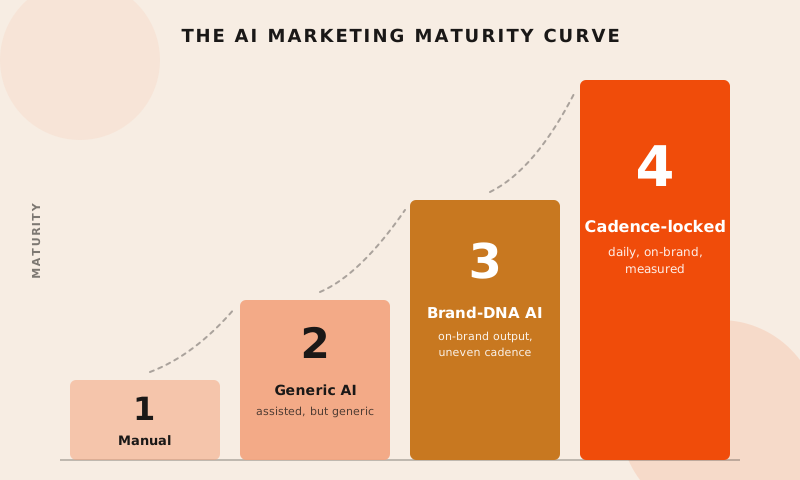
The four stages of AI marketing maturity. Most brands today sit at Stage 2.
Stage 1: Manual marketing (no AI)
The team makes content by hand. Briefs, agency rounds, designers in Figma, copywriters in Google Docs. Output is often polished but slow, and the team can't keep pace with the channels they're committed to.
You're at Stage 1 if:
- Your weekly content cadence depends on one designer or one copywriter being available
- You measure success by polish, not by frequency or reach
- "Run a campaign" still means a 4 to 6 week cycle
The leap to Stage 2 is buying a tool. It costs nothing in strategy and everything in identity.
Stage 2: AI-assisted, but generic
The team has adopted ChatGPT, Midjourney, or a stack of tools. Volume is up. But the content sounds like every other brand using the same tools. No one trained the AI on what makes you, you.
You're at Stage 2 if:
- Your captions could swap with a competitor's and no one would notice
- Your imagery looks like 2024 stock-AI: same lighting, same angles, same vibes
- You ship more, but engagement and conversion didn't move
This is where most brands sit right now. We see it constantly. And it isn't invisible to your audience: a 2025 study found that 82.1% of Americans can spot AI-generated content at least some of the time, climbing to 88.4% among younger consumers (Column Five Media, 2025). Generic AI doesn't just bore your audience. It actively erodes their trust.
The fix isn't more tools, it's training.
Stage 3: Brand-DNA AI
The AI is now taught what your brand is: voice, visuals, audience, and point of view (the four layers we covered in our post on Brand DNA). Output sounds like you. People notice.
You're at Stage 3 if:
- A new piece of content gets recognized as "yours" without a logo
- Your team approves more drafts than they reject
- Each campaign feels distinctive, but cadence is still uneven
The catch: Stage 3 brands ship great campaigns, then go quiet for two weeks. The DNA is solved, the rhythm isn't.
Stage 4: Cadence-locked
Daily on-brand output across channels. Not the perfect post every day, but the right post every day. The brand stays present, the AI keeps producing, the team reviews and ships.
You're at Stage 4 if:
- Your audience hears from you on a predictable rhythm without it feeling forced
- Your team spends mornings reviewing, not making
- Missing a day feels like a system failure, not a normal week
Stage 4 isn't an endpoint, it's a working rhythm. Brands at Stage 4 keep refining their DNA and their measurement, but the engine runs. Buffer's analysis of more than 100,000 accounts found that regular posting drives roughly 5x more engagement than inconsistent posting (Buffer, 2026). Consistency isn't an aesthetic choice. It's a measurable lever.
How do I find my stage in 60 seconds?
Ask three questions:
- Could a stranger pick your content out of a lineup of competitors? No = Stage 1 or 2. Yes = Stage 3 or 4.
- Is your cadence weekly or better on at least two channels? No = Stage 1, 2, or 3. Yes = Stage 4.
- Do you have AI in the workflow at all? No = Stage 1. Yes = at least Stage 2.
Most readers will land at Stage 2. That's expected.
Why most brands stall at Stage 2
The Stage 2 plateau is the real story of this series. Brands buy AI, ship more content, then wonder why their numbers didn't move. The next post in this series goes straight at it: what's actually keeping you stuck, and the systems-level fix.
Adopting AI moves you from Stage 1 to Stage 2 in days. Climbing past Stage 2 takes a different kind of work.
What's next in this series
This is post 1 of 5. Coming up:
- Post 2: Stuck at generic AI - what's actually keeping your brand there
- Post 3: From generic AI to on-brand AI, in one day
- Post 4: Polished weekly vs on-brand daily - which AI marketing actually wins
- Post 5: Zero to daily cadence in 4 weeks - a local ergo furniture brand's playbook
FAQ
Frequently asked questions
Traditional digital marketing maturity models track tooling adoption (analytics, automation, CRM). The AI marketing maturity curve tracks something different: whether your output sounds like your brand and whether you can sustain a cadence. Adopting more tools doesn't move you up. Teaching the tools your brand and locking a rhythm does.